
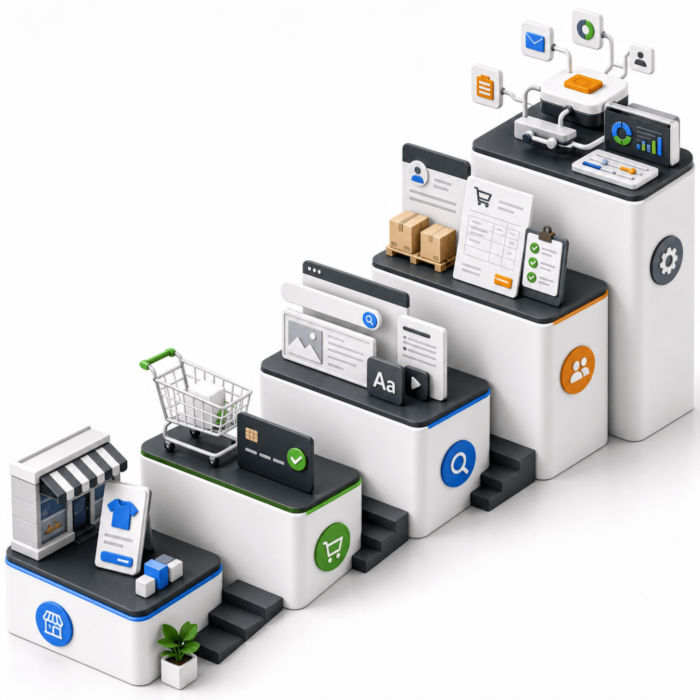
How to choose Magento 2 modules for your store's stage of growth: launch, growth, B2B, SEO, automation
A Magento 2 store can be expanded for a very long time, but that does not mean it makes sense to implement everything right away. In practice, the biggest problem is not having too few modules, but making decisions in the wrong order. A store at launch installs features meant for mature B2B operations, while a store with high traffic still has not solved a basic issue with the product page, cart, or indexing.
That is why choosing Magento 2 modules should be based not on the longest possible feature list, but on the store's stage of growth. Different extensions are a priority at launch, different ones when the store is growing, others in B2B sales, and still others for automation and multichannel operations.
Below, we show a simple selection logic: what to implement first, what later, and which modules only make sense once the store already has its foundations in place. If you also want to look at this topic from the perspective of automation and artificial intelligence, a good companion read is How to implement AI in Magento 2 in a way that makes business sense: from product support to cart recovery.
Why poor module selection costs more than having none
In Magento 2, it is easy to reach a situation where a store has many extensions but few real benefits. This usually happens for one of four reasons:
- features are implemented too early,
- modules solve symptoms instead of the main problem,
- several extensions overlap in the same area and make maintenance more complex,
- the store pays for implementation and configuration of things that do not yet deliver a return.
The example is simple. If a store does not have a clear product page, has a weak checkout, and does not communicate the basic purchase benefits, then implementing advanced marketing automation will be premature. Before you start recovering abandoned carts, you first need to reduce the number of carts being abandoned for obvious reasons.
The same applies in B2B. If a company only needs sales for logged-in customers and registration approval, there is no reason to start with an advanced affiliate program or sophisticated AI features. First, you need to organize the logic of access, purchasing, and B2B customer service.
So the best module selection is not about asking what else can we add, but rather what is most limiting sales, visibility, or operational efficiency today?
Launch stage: start with the store foundation
At launch, a Magento 2 store primarily needs clarity. The customer must understand the offer, move easily through the product page and cart, and the store should have the basics of technical SEO along with solid information presentation.
At this stage, it is usually not yet about highly complex automation. The priority is making sure the store is understandable, consistent, and ready to sell.
A good set of launch modules most often includes:
- Simple and intuitive Magento 2 cart,
- Magento 2 module Store information icons and product features,
- Magento 2 module Additional tabs on the product page,
- Product labels for Magento 2,
- Magento 2 module - Robots tag management,
- Magento module that fills in image ALT text based on product attributes.
This kind of set does not sound spectacular, but that is exactly why it works. It provides a foundation for UX, technical SEO, and better offer presentation without overloading the store with features that require a more mature sales process.
At this stage, it is worth thinking in terms of:
- does the customer understand what they are buying,
- is the product described well enough,
- is the most important information visible without unnecessary searching,
- is the store blocking indexing or neglecting SEO basics.
If the answer to these questions is not yet, then it is better to develop the foundation first and only later add conversion, B2B, or AI layers.
Growth stage: when the store already has traffic and conversion needs improvement
When the store is operating stably, has its basic offer organized, and starts attracting traffic, the priority changes. At that point, the most important thing becomes reducing purchase friction and closing more sales effectively.
At this stage, it makes sense to focus on modules that:
- help the customer make a decision faster,
- improve communication of benefits,
- support cart value,
- recover sales that were already close to completion.
Solutions that work well here include:
- Automatic Related Products for Magento 2,
- Free Shipping module for Magento 2,
- Magento 2 module - Payment Icons on the Product Page,
- Checkout Success Page with a custom CMS block and order details,
- Available Promotions - displaying promotions on the product page,
- Estimated delivery date for Magento 2.
At this stage, the store is already beginning to work with user behavior data. You can see where customers hesitate, which questions keep coming back, which offer elements help close sales, and where the most abandonment happens.
That is exactly why growth modules should be selected based on a specific obstacle:
- if customers do not understand the value of the offer, communication on the PDP needs to improve,
- if uncertainty appears in the cart, it is worth presenting delivery and payment options more clearly,
- if customers view the product but do not complete the purchase, the buying decision needs improvement, not just more traffic.
This is also the moment when you can move from thinking module as a feature to thinking module as a conversion improvement tool.
SEO and content stage: when the catalog should drive visibility
In many Magento stores, SEO is treated as a separate layer added later. That is a mistake. If the catalog is extensive and the store wants to grow steadily through organic traffic, it needs not only content but also the right structure and technical control.
At this stage, it is worth thinking more broadly than just meta title and category description. The entire indexing architecture matters:
- URLs,
- structured data,
- categories,
- images,
- rich snippets,
- the way content and publication changes are managed.
Modules that fit well here include:
- CustomUrlRewrite - Automatic URL Conflict Resolution,
- Custom Title and Description for Magento 2 categories,
- Meta OG module for Magento 2,
- Magento 2 module - SEO Rich Data JSON-LD,
- Google Indexing API for Magento 2,
- Kowal Blog for Magento 2.
This is a set for stores that want to manage visibility better, not just add a bit of content. Especially important here is combining technical SEO with the publication process. A store that regularly expands its offer needs not only good descriptions but also control over:
- which URLs are correct,
- how structured data looks,
- how quickly new or updated pages get indexed,
- whether the blog and content are truly part of the store rather than a separate add-on next to the catalog.
If the store is already at the stage of serious content work, it is also worth reviewing the SEO and content optimization category, as well as the material Magento module packages for online stores, because this area grows best as a set of related improvements rather than a single feature.
B2B stage: when the purchasing process must support different rules
B2B sales in Magento 2 do not start with the store's appearance. They start with access logic, customer approval, ordering rules, and company data. That is exactly why business-focused stores need a different set of extensions than classic B2C.
At this stage, the priority is modules that organize the sales model itself:
- Magento 2 B2B Forced Login,
- Magento 2 Customer Approval,
- Quick B2B orders for Magento 2,
- Kowal_Gus - Automatic company data retrieval from GUS,
- Payment and shipping restrictions for Magento 2,
- Redirect customer after login by customer group.
In this area, order matters. First, you need to answer the following questions:
- should everyone be able to see the offer,
- does the customer require approval before purchase,
- does the store have different rules for different customer groups,
- do purchases need to be faster than in the standard checkout,
- should company data be retrieved and validated automatically.
Only after organizing this layer does it make sense to expand into more advanced B2B features, individual discounts, additional forms, or automations specific to the business relationship.
If the store is genuinely developing its B2B model, it is also worth comparing modules in the B2B Modules category, because that is where you can best see which extensions strengthen registration and which support purchasing, logistics, and partner service.
Automation and integration stage: when the store cannot grow manually
At a certain point, the frontend stops being the main issue. The team starts losing time to manual data transfers, marketplace handling, attribute exports, orders, and stock synchronization. That is exactly when the automation and integration stage begins.
At this point, the store should reduce manual work instead of simply adding more customer-facing features. Well-chosen modules can relieve the team more than many frontend changes.
In practice, it is worth looking at solutions such as:
- Integration of a Magento store with the wFirma invoicing and inventory system,
- Magento 2 integration with eMAG Marketplace,
- Magento 2 BaseLinker Stock Export,
- Export Import Categories module for Magento 2,
- Export selected product attributes to CSV,
- Magento 2 Kowal Order Import Module.
This is the right stage for stores that:
- have an increasing number of orders and sales channels,
- sell outside Magento itself,
- use external systems for invoices, ERP, marketplaces, or logistics,
- do not want business growth to mean a proportional increase in manual work.
In this area, the biggest mistake is implementing integrations without order in the data. If attributes, categories, SKU mapping, or stock logic are inconsistent, integration will not simplify the process - it will only move the problem faster into another system.
That is why automation works best when the store already has basic product and operational order in place. Then modules from the External Integrations and Data Export / Import categories start to genuinely reduce operating costs.
AI stage: when it makes sense to move up a level
AI should not be the first step. It delivers the greatest value only when the store already has meaningful data, processes, and knows exactly where it is losing time or revenue.
In a well-prepared Magento 2 store, AI can support:
- the product knowledge base,
- responses to customer questions,
- content translation,
- review moderation,
- abandoned cart recovery.
At this stage, it is worth looking at solutions such as:
- Kowal AI Product Feed for OpenAI Vector Store,
- AI Product Support for Magento 2,
- AI-powered cart recovery assistant,
- Automatic review moderation in Magento 2 with AI,
- Bulk product translation in Magento 2 with ChatGPT.
This is the stage for stores that do not want to implement AI just because they should, but want to use it to improve a specific process. If the catalog is poorly described, the FAQ does not exist, and the content structure is chaotic, that needs to be organized first. Only then does AI start working as a real growth tool.
So it is worth treating AI as a higher-level layer. It does not replace the store's foundation, but it can greatly strengthen mature areas of it. If you want to explore this topic more broadly, useful additions include Magento modules that work with AI, the AI-based extensions category, and the article How to implement AI in Magento 2 in a way that makes business sense: from product support to cart recovery.
How to determine the implementation order
If the store is facing a long list of needs, the safest order usually looks like this:
- first, problems that directly affect sales and how understandable the offer is,
- then technical issues related to SEO, visibility, and data quality,
- next, operational processes that consume the most team time,
- only later, more advanced automation, integrations, and AI.
This approach helps avoid a classic mistake: implementing expensive features on an unstable or inconsistent foundation.
It is also a good idea to return to a few simple questions after each stage:
- what improved from a business perspective,
- what improved operationally,
- did the given module actually solve the problem,
- what is the next logical step, and what is only an attractive extra.
Magento 2 offers a great deal of flexibility, but that is exactly why it requires selection. A store does not need a long list of extensions. It needs the right modules at the right time.
Magento 2 modules should be chosen by stage, not by impulse
Not every Magento store needs the same extensions, and not every problem requires a large implementation package right away. Sometimes the biggest impact comes from improving the product page and cart. Sometimes from order in SEO and indexing. Sometimes from B2B logic. Sometimes from integrations that reduce manual work for the team.
The most important thing is to choose modules based on the store's stage of growth and the real business problem. Only then does implementation make economic, technical, and operational sense.
If you do not know which Magento 2 modules to implement first, start with a simple breakdown: launch, growth, SEO, B2B, integrations, and AI. This structure organizes decisions much better than randomly adding more extensions to an existing store.
If you want to browse the full offer, the starting point remains the Magento modules page. If, on the other hand, you want to make the selection faster, it makes sense to start by identifying the store stage, sales model, and biggest operational problem. A useful addition can also be Magento module packages for online stores, because they present the same topic from the perspective of ready implementation directions.
