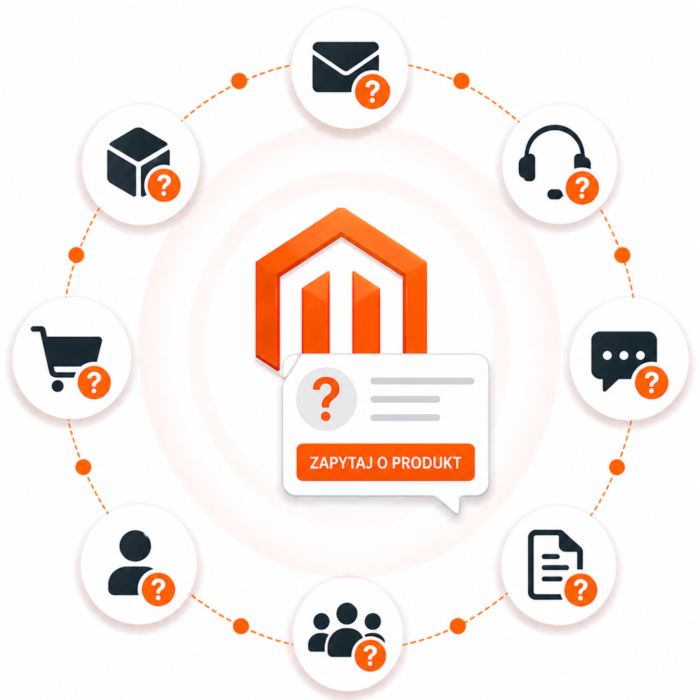
Kowal_ZapytajOProdukt is an advanced Magento 2 module for customer communication on the product page. It combines a classic question form, structured FAQ, and an AI Assistant in one consistent solution.
In practice, this means the product page is no longer just a place to present a description and technical parameters, but becomes an active support point for customer questions. The user can:
- ask a standard question about the product,
- use ready-made answers published in the FAQ,
- chat with the AI Assistant, which responds in the context of the product currently being viewed.
The module was designed to solve two problems at the same time:
- support-related, meaning it helps reduce the number of repetitive questions sent to the store team,
- product-related, meaning it builds a growing, structured knowledge base that improves the quality of answers over time.
Business goal
In many online stores, a significant share of customer questions is repetitive:
- whether the product is compatible with a specific Magento version,
- whether it works without an additional module,
- how the installation process works,
- whether it supports multiple languages,
- whether it requires custom changes to the theme,
- how it behaves in a specific business scenario.
Without a dedicated support tool, these questions:
- burden support,
- slow down purchase decisions,
- scatter knowledge across email inboxes, tickets, and sales conversations,
- do not return to the store as a structured FAQ.
This module organizes that process. First, it collects questions and answers, then organizes them into an FAQ, and in the next stage uses them as context for the AI Assistant and the retrieval layer based on OpenAI Vector Store.
Core idea of the solution
The module works in layers.
Layer 1. Classic product questions
A standard question submission mechanism can be enabled on the product page. The customer sends an inquiry, and the administrator or store staff receives it for further handling. This is the simplest and most predictable form of contact.
Layer 2. FAQ
Recurring questions and answers can be saved and published as a product FAQ. The FAQ can be displayed as a tab or as a separate section on the product page. This allows future visitors to get an answer without having to submit a new question.
Layer 3. AI Assistant
A lightweight AI conversation component appears above or below the standard FAQ. The user can:
- click one of the popular questions,
- enter their own question in the
Zapytaj Asystenta o ten produkt. field, - see the answer in the same conversation area.
The Assistant does not work as a general store chatbot. It was designed as a product assistant, which means the answer should be based primarily on:
- data from the current product,
- published FAQ entries,
- the history of the current conversation,
- optionally, retrieval results from OpenAI Vector Store.
Functional scope of the module
The module provides a classic customer contact mechanism.
Key elements:
- a
Zapytaj o produkt button or form on the product page, - AJAX handling on the frontend,
- saving the question to the database,
- option to send an email notification,
- option to enable the module globally or only for selected products.
This solution still makes sense even when the store already uses the AI Assistant. Not every question should be handled automatically. Some cases require a sales response, an individual quote, or confirmation by the technical team.
2. FAQ on the product page
The FAQ in this module is not a marketing add-on, but a structured knowledge layer about the product.
The administrator can:
- review saved questions,
- add answers,
- publish selected records,
- display them on the product page.
The FAQ can be shown:
- as a tab,
- as a separate section on the product page.
What matters is that the FAQ is not only used by the frontend. Published questions and answers are also used as one of the most important context elements for the AI Assistant.
3. AI Assistant on the product page
The AI Assistant is the central element of the module expansion.
The component is embedded on the product page, by default under the gallery, and has been prepared to:
- run lightly on the frontend,
- avoid unnecessarily burdening the first page render,
- be readable on desktop and mobile,
- be suitable for further development.
The user sees:
- the section title,
- introductory text,
- a single text field for asking a question,
- a list of the most popular questions,
- a conversation area that expands with subsequent questions and answers.
In the current version, the form also supports:
- conversation history within the session,
- clickable popular questions,
- feedback for AI answers,
- two color variants: light and dark.
4. Popular questions
The most popular product questions can be displayed below the text field.
This solution serves several functions at once:
- speeds up the start of the conversation,
- suggests to the customer what others ask about most often,
- allows ready-made FAQ answers to be used without the cost of an AI model request,
- improves UX and reduces the number of empty interactions.
Question popularity is no longer based only on manual order. The module collects data about clicks, submitted questions, and feedback, then ranks the FAQ based on that data.
5. AI answer context
The most important design assumption was that AI should not answer out of context from the product.
The answer can be built based on several sources:
- basic product data,
- short description,
- full description,
- selected product attributes,
- published FAQ entries,
- conversation history.
Additionally, the module lets you limit which attributes are sent to the model, so you can avoid:
- overloading the prompt,
- sending unnecessary data,
- excessively high token cost,
- accidentally passing content that is not useful to the customer.
6. Integration with OpenAI Responses API and Vector Store
One of the key expansion elements is integration with OpenAI Responses API.
In simpler scenarios, the module can operate in local product and FAQ context mode. In more advanced implementations, it supports:
file_search,vector_store_ids,- filtering by
sku, - filtering by
product_sku, - filtering by
store_code, - filtering by
content_type, - limiting the number of retrieval results,
hybrid mode,retrieval-first mode.
This means the AI answer can be based not only on data passed directly from Magento with a given request, but also on documents previously added to Vector Store.
In practice, this provides two benefits:
- lower cost, because the entire dataset does not need to be sent to the model each time,
- better scalability, because retrieval can handle a larger knowledge base than a simple prompt with local JSON.
7. Integration with Kowal_AiProductFeed
The module has been prepared to work with Kowal_AiProductFeed.
This integration allows you to:
- synchronize product data to OpenAI Vector Store,
- use documents such as
product.core, product.faq, product.docs, and others, - resynchronize a selected product before the conversation,
- limit retrieval to specific content types.
This approach is especially useful where:
- product descriptions are long,
- the FAQ is extensive,
- the store handles many technical products,
- product data is continuously developed.
8. Analytics and feedback
The module does not stop at generating the answer itself.
It also saves data that helps assess whether the solution works:
- number of FAQ clicks,
- number of submitted questions,
- helpful / not helpful ratings,
- conversation history,
- technical metadata of AI answers,
- token usage,
- request and response payload, if you enable diagnostic logging.
This means the implementation is not a black box. The team can analyze:
- which questions appear most often,
- whether AI uses retrieval,
- whether the answers are accurate,
- which records are worth saving permanently as FAQ entries,
- how cost and quality change after modifying the prompt or configuration.
9. FAQ candidates and administrative workflow
One of the most important advantages of the module is the ability to turn conversations into new FAQ entries.
The process works as follows:
- Customers ask questions.
- The module saves conversations.
- The analysis mechanism identifies FAQ candidates.
- The administrator reviews candidates in the panel.
- After approval, the candidate is added to the standard product FAQ.
This is a very practical workflow because knowledge does not get lost in conversation history. With each iteration, the store builds a better answer layer:
- for customers,
- for the FAQ,
- for the AI Assistant,
- for future retrieval.
10. Security and control
The module has been prepared so its operation can be controlled.
The configuration includes, among other things:
- access restrictions for guests,
- conversation TTL,
- request limits,
- input data sanitization,
- diagnostic logging options,
- reCAPTCHA configuration,
- a controlled scope of data sent to the model.
This is important because implementing AI on the product page should not mean losing control over:
- cost,
- data,
- answer quality,
- frontend load.
11. Who this module is for
The module works best in projects where:
- the catalog is larger than a few simple products,
- customers often ask about compatibility, configuration, or implementation,
- the team wants to combine a classic FAQ with a modern AI layer,
- the company develops product documentation and wants to use it in retrieval,
- control over what AI knows and where it gets answers from is important.
It is especially well suited for stores selling:
- Magento modules,
- technical products,
- B2B solutions,
- tools that require implementation or configuration,
- products where the customer expects a fast and precise answer before purchase.
12. Summary
Kowal_ZapytajOProdukt is no longer just a module for a simple contact form on the product page.
It is a complete product communication layer that:
- collects questions,
- publishes FAQ entries,
- answers through AI,
- uses Vector Store,
- analyzes conversations,
- and turns them into an increasingly better store knowledge base.
As a result, the product page becomes a place for a real conversation with the customer, not just a static page with a description and price.

 WhatsApp
 +48608012047