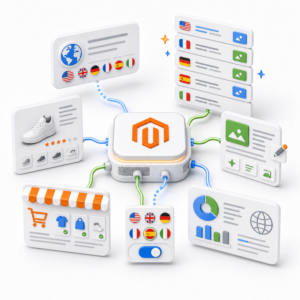
Bulk product translation in Magento 2 with ChatGPT – save time and money
Magento Modules: Clear Guidelines
You purchase the module once, with no domain restrictions
Free installation and updates via Composer
Affiliate Program
Technical support for Magento
Clear guidelines for licensing Magento modules
Magento Module Code Security
Expanding your offer into new markets is one of the biggest challenges for companies selling online. A key element of successful expansion is translating product descriptions into the language of the target country. However, this requires significant financial and time investment. With the Magento 2 module integrated with ChatGPT, this process can be fully automated, significantly reducing the cost and time spent on manual translations.
Artificial intelligence as a revolution in e-commerce translation
Artificial intelligence (AI) is playing an increasingly important role in various aspects of business, including translation. Modern language models such as ChatGPT are based on vast data resources and advanced algorithms that make it possible to generate fluent, natural, and contextual translations. As a result, even complex technical descriptions and specialized industry terms can be translated with high accuracy. Using AI for translation eliminates errors caused by literal translation and makes descriptions understandable and attractive to customers in different markets.
Model fine-tuning for better translation quality
To improve translation quality even further, it is possible to fine-tune the ChatGPT model. This means additionally training it in the subject matter of a specific industry, allowing it to better understand specialized terms and translation context. For example, if a company sells automotive parts, the model can be adapted to better interpret technical descriptions and abbreviations used in that field. Fine-tuning makes translations even more precise and tailored to customer needs, which improves the readability and reception of the content.
Product translation – the key to global sales
Businesses planning to enter new markets often face a language barrier. Many companies, especially suppliers and distributors, receive product descriptions in English (EN) or German (DE). Translating them into Polish or another required language usually involves hiring translators or translation agencies, which generates significant costs.
By using the Magento 2 module integrated with ChatGPT, you can save up to several thousand PLN per month on translations. ChatGPT provides high-quality, contextual translations that are comparable in quality to professional translation services, while the cost of this solution is many times lower.
How does the automatic translation module in Magento 2 work?
The module has been designed for ease of use and process automation. The entire process of translating product descriptions comes down to a few steps:
- Select products – the user selects the products that require translation from a list.
- Specify the target language – simply define the language into which the descriptions should be translated.
- Automatic translation – the module uses ChatGPT to translate product descriptions quickly and accurately.
- Save and publish – the completed translations are saved directly in Magento 2.
Cost and time savings – key benefits
- Significant cost reduction – eliminates the need to hire expensive translation services.
- Fast performance – translating hundreds of products takes just a few hours.
- Scalability – an ideal solution for companies that regularly receive new products to introduce to the market.
- Good-quality translations – thanks to advanced NLP technology, ChatGPT generates natural-sounding texts adapted to the context.
An ideal solution for e-commerce
Companies planning to expand into new markets or frequently working with products received in foreign languages will find this module an excellent support tool. Automating the translation of product descriptions enables rapid adaptation of the offer to local customers, which translates into better search engine visibility and greater buyer trust.
With Magento 2 integrated with ChatGPT, translating product descriptions becomes simple, affordable, and highly effective. It is a solution that can significantly contribute to sales success in international markets.

Translating and generating category content in Magento 2
Automatic category translation with ChatGPT
The Kowal MassTranslate by ChatGPT module has been extended with advanced support for translating and generating content for Magento 2 categories.
This solution is ideal for multilingual stores where the category structure is extensive and requires consistent, SEO-optimized content in multiple language versions.
How does it work?
The administrator selects a category in the Magento panel.
With one click, they launch the Translate Current Category and Childs action.
The module:
collects the category data and all of its subcategories,
generates a JSONL file,
sends the data to ChatGPT in batch mode,
saves the translation results in the task system.
CRON automatically saves the translated content to the appropriate store view.
The entire process runs in the background, without the risk of timeouts and without overloading the admin panel.
Supported category attributes
The module allows content to be translated or generated for, among others:
category name (name)
category description (description)
meta title, meta description, meta keywords
url_key (while maintaining SEO rules)
custom text attributes (varchar, text)
The attribute scope and prompt are fully configurable from the module settings.
SEO and data security
Translations are saved only in the target language version (store view).
The module creates a backup of the original category values before saving new content.
Support for url_key ensures correct SEO links without the need to save the category manually.
No uncontrolled cache invalidation – a production-safe solution.
Who is this functionality for?
multilingual Magento 2 stores (B2C and B2B),
stores with an extensive category tree,
projects requiring consistent SEO across multiple languages,
teams that want to automatically generate category descriptions, not only translate them.
1. Introduction
The Mass Translate by ChatGPT module in Magento 2 enables automatic translation of product descriptions, allowing you to quickly adapt your offer to new markets. Translated content is saved in the selected store view.
Module installation
To install the module, simply:
- Install the module: - Add the composer repository to the configuration by running
composer config repositories.masstranslatebychatgpt vcs https://github.com/kowalco/magento-2-mass-product-translate-by-chatgpt
Add an access token for the private repositorycomposer config --global --auth github-oauth.github.com <YOUR_TOKEN>
Install the composer module by runningcomposer require kowal/module-masstranslatebychatgpt
Enable the module by runningphp bin/magento module:enable Kowal_MassTranslateByChatGPT
- Run the commands:
bin/magento setup:upgrade bin/magento setup:di:compile bin/magento cache:flush bin/magento indexer:reindex sales_order_grid
2. Module configuration
To configure the module, go to:
Admin Panel Magento 2 → Stores → Configuration → KOWAL → Mass Translate by ChatGPT - Settings
or
Admin Panel Magento 2 → KOWAL.co → Mass Translate by ChatGPT - Settings
2.1. General settings
- Enable Module – Enables or disables the module.
- OpenAI API Key – API key for communication with ChatGPT, which you can generate here
- Max Translations per Day – Maximum number of products to translate per day.
Defines the limit of products that can be translated within one day. The limit depends on the size of product descriptions.
2.2. Translation settings
- Source Language (source language) – Select the language and Store ID.
Select the language from which the content will be translated.
Important! Selecting a language also means selecting the Store ID, meaning the store view from which the original texts will be retrieved.
- Target Language (target language) – Select the target language and Store View.
Select the language into which the products should be translated.
Important! Defining the target language also means selecting the store view where the translated content will be saved.
- AI Model Instructions – Instructions for ChatGPT.
You can customize the commands for ChatGPT.
Example: Translate the specified attributes from Polish to English.
- AI Model – Select the AI model.
- Attributes to Translate – List of attributes to translate.
Specify which product fields should be translated, for example:
Description (product description)
Image Label (image label)
Instructions (usage instructions)
Compatibility (compatibility data)
3. Translating products
- Go to Catalog -> Products.
- Select the products for translation by checking the checkbox next to them
- Select the bulk translation option.
Click the actions menu and choose the translation-related command.
The system will start processing, and the products will be sent to OpenAI.
- You will be automatically redirected to the Tasks section to track progress.
4. Monitoring translation tasks (Translations)
To check task status:
- Go to the Translations section.
- There you will find a list of all requested translations with details:.
Status – completed (completed) or error (error).
Products – how many products have been translated.
ChatGPT Model – which AI model was used.
Tokens Input/Output – the number of tokens processed in the request.
Instruction – the AI command used.
Language From / Language To – source and target language.
Task statuses
completed – translation completed successfully.
error – translation error.
If the translation failed, check:
Whether the entered OpenAI API key is correct.
Whether the selected AI model is supported.
Whether the daily translation limit has not been exceeded.
5. Reviewing and saving translated content (Product Tasks)
- Go to the Product Tasks section.
- There you will find detailed data for translated products
ID – translation task identifier.
- Status – status of saving the translated text.
SKU – product catalog number.
Store ID – store view where translations will be saved.
Translated Attributes – translated product fields.
Created At – date when the translation was performed.
6. Summary
The Mass Translate by ChatGPT module automates product translations, saving time and resources. You can:
- Select the language and Store View for translations.
- Monitor translation progress.
- Saved translations are available in the selected store view.
This solution significantly simplifies the management of an international product offer in Magento 2.
Version: 1.0.50
24.01.2026
New functionality - Category content translation and generation
Added support for Magento 2 category translation using ChatGPT (Batch API).
Ability to translate a single category or the entire category tree (category + childs).
New Translate Current Category and Childs button in category editing in the admin panel.
Support for translating and generating content for category attributes:
name
description
meta_title
meta_description
meta_keywords
url_key
other text attributes of type varchar / text.
Correct handling of store view scope – data is saved only in the target language version.
Automatic support for SEO-friendly URL Key for categories (without the need to save manually in the panel).
Safe data saving without a full save() – no issues with cache and Varnish.
Logic and security:
Introduction of a category attribute backup system before saving translations.
Translation results are saved in a separate categorytasks table with status support (pending, completed, error).
Translation results are processed by CRON, without overloading the admin panel.
Full compatibility with Magento 2.3.x – 2.4.x.
Optimizations:
Data processing in batches (JSONL) – ideal for large category trees.
Ability to centrally manage the prompt and attribute scope from the module configuration level.
VITCAS Ltd is a brand with a highly technical product range: high-temperature materials, insulation, adhesives, seals, and products whose descriptions are not marketing copy, but precise information: parameters, standards, operating temperatures, applications, warnings, instructions, and often multi-level content formatting.
When launching the Italian version of the store negozio.vitcas.it, our task was to translate the entire product database into Italian in a way that:
preserved the technical meaning without attractive but incorrect translations,
did not disrupt the structure of descriptions, including headings, lists, spacing, and paragraphs,
could be implemented quickly without manually rewriting content.
It was a real-world test, and this is where the module showed its greatest value. The translations generated in the process:
were very strong in terms of subject matter accuracy, preserving the technical context, values, and meaning of the content,
maintained the formatting of product descriptions, including lists, paragraphs, and content layout, so no manual cleanup was needed,
made it possible to launch the Italian store version in a short time, without a lengthy step-by-step translation process.
Most importantly, the implementation was simple: store view configuration, product selection, and starting the translation process. No Excel exports, no copy and paste, and no additional tools along the way. Once the process was complete, the content was saved directly in the target store view and ready for publication.
The result of this implementation was strong enough that, after the successful translation and launch of the Italian version, the client commissioned additional markets: the Netherlands, Sweden, and the Czech Republic. The module is therefore not a one-time trick, but a tool for scaling content that works especially well where descriptions are demanding and accuracy matters.
The client running the 4japancars.pl store needed an efficient way to continuously translate products from English into Polish. With a dynamically changing assortment, the key requirement was not only a one-time translation of the database, but above all implementing a process that works continuously — without queues, without manual content copying, and without involving a developer for every new product.
After purchasing our module, the client quickly incorporated it into daily work. After a short training session, they are able to manage the entire process independently: select products, start translations, and publish completed Polish content on an ongoing basis as new products are added.
What worked particularly well in this implementation:
Ease of use after implementation — the client works independently, without the need for ongoing support.
Fast, repeatable process — translations can be completed exactly when they are needed.
Clear and consistent Polish content — names and descriptions are understandable for the end customer.
Up-to-date catalog — new products do not “wait for a translator”; content is ready on an ongoing basis.
Result: the store keeps Polish product descriptions up to date at all times, and the team does not waste time manually rewriting content or moving data between tools. The module has become a practical tool for daily work and has significantly improved the process of publishing products in Polish.
lampywcentrum.pl is a very large-scale store: tens of thousands of products from multiple wholesalers and about 80,000 active offers, with dozens of new products added every day. In this situation, the biggest challenge is not simply adding a product to Magento, but the quality and completeness of content — especially when wholesalers do not provide full descriptions and SEO data.
In practice, the main missing elements were:
meta title
meta description
short description
These are exactly the elements that have a major impact on SEO, click-through rates in search results, and the quality of product presentation in listings.
How was the module used?
In this project, the module works as a content generator, not a classic “language translator.”
The configuration was set to:
attribute translation PL → PL
translation of only selected attributes (meta title, meta description, short description)
prompts included an instruction for the module to complete missing text where an attribute is empty or requires meaningful content
As a result, the company can automatically fill in incomplete product data received from wholesalers — without manually writing descriptions and without slowing down the process of adding new products.
What did this change in daily work?
Control at scale: with tens of thousands of products, manually creating descriptions and metadata would be unfeasible.
Consistent SEO quality: new products can receive meaningful metadata and a short description right away, instead of remaining “empty” for weeks.
Process automation: content is generated systemically, according to the defined prompt and attribute scope.
Up-to-date catalog: with daily product growth, items become “sales-ready” faster and are presented better in the store.
As a result, the module became a tool for lampywcentrum.pl to organize and complete content across a huge product catalog — especially in SEO and product presentation — exactly where wholesaler data is most often incomplete.