
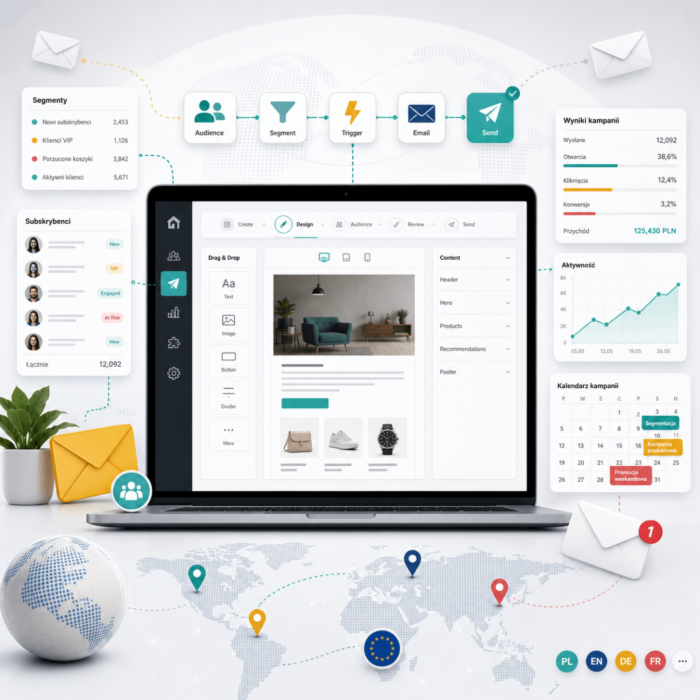
This Is No Longer Just a Newsletter. It Is Built-In Email Marketing in Magento
In many online stores, the newsletter still operates in a model from years ago: a separate signup form, a separate recipient database, a separate message builder, a separate schedule, separate reports, and between all of that, synchronizations and more integrations with an external SaaS. From an operational perspective, this is costly, slow, and unnecessarily complex.
After reviewing the modules attached to this project, it is clear that we are no longer talking about an advanced newsletter. This is a complete email marketing ecosystem embedded directly in Magento. It includes subscription capture, marketing consent, audience management, lists and segments, content creation, campaign scheduling, sending, queues, tracking, and an operational dashboard.
Most importantly, this entire process stays where customer data, store context, product offerings, store view, and sales logic already exist: in Magento.
Why This Is More Than a Newsletter
The package structure itself clearly shows the scale of the solution:
Advance Email Deliveryorganizes the sending layer itself.Advance Email Delivery and Trackingadds monitoring and observability.Advanced Newsletter Suitebrings together recipients, content, campaigns, subscription frontend, and the operational panel into one whole.
So this is not a single module for sending mailings, but a set of specialized components that together build an internal email marketing system for Magento.
In practice, this ecosystem consists of several layers:
MarketingCoreas the shared core for configuration and message types,EmailTransportandEmailSmtpas the layer for routing, sending accounts, fallbacks, and logs,NewsletterAudienceas the model for recipients, lists, segments, consents, and metadata,NewsletterCaptureandNewsletterFrontendas the subscription capture layer,EmailTemplateStudioas the environment for building newsletter content,NewsletterCampaignsas the engine for campaigns, schedules, queues, and batches,NewsletterConsoleas the operational dashboard,- the email event layer responsible for tracking opens, clicks, and delivery statuses.
This division matters from a business perspective. Instead of one all-in-one tool, the store gets a system that can be developed in stages, but in the target setup works like its own email marketing platform.
What This Package Can Actually Do
From a functional perspective, this solution covers nearly the entire lifecycle of an email campaign.
1. Subscription Capture Without Leaving Magento
The NewsletterFrontend layer provides forms, widgets, and a newsletter popup directly on the store frontend. On top of that, there is Page Builder integration, configuration of form content, visual variants, layout, consent checkboxes, and the unsubscribe link.
This matters because subscription is no longer just an extra tucked away somewhere in the footer. It becomes a normal part of the store and the marketing funnel, managed from the same panel as the rest of the communication.
2. Marketing Consents and Double Opt-In
NewsletterCapture supports double opt-in, confirmation token lifetime, and tokenized campaign unsubscribes. NewsletterAudience also stores consent history, consent source, IP, and additional proof data.
This means the store does not just collect email addresses, but builds an organized marketing database with consent history and subscription status.
3. Your Own Audience Database, Lists, and Segments
This is one of the strongest elements of the entire suite. The NewsletterAudience module extends native Magento subscribers with:
- subscriber metadata,
- acquisition source,
- acquisition channel,
- mailing lists,
- dynamic segments,
- bulk operations,
- CSV export.
In campaigns, manual lists can be combined with dynamic segments, and the system even shows audience estimates and a breakdown of how many recipients come from lists, how many from segments, and where overlap occurs. This is no longer a simple table of email addresses, but a real audience management layer.
4. Creating Newsletter Content in Magento
EmailTemplateStudio is one of the modules that most strongly shifts this solution from the newsletter level to the email marketing level.
The code shows that the module provides:
- work based on native Magento newsletter templates,
- a builder based on GrapesJS and MJML,
- product selection for the mailing section,
- ready-made product layouts,
- compilation to email-safe HTML,
- preview of the result before using it in a campaign.
This is a very practical approach. Marketing does not prepare content in one system, manually copy it into another, and separately check whether the final HTML will pass through email clients. Content is built in the Magento context, based on store products, and then goes directly into the campaign.
5. Campaigns, Scheduling, and Queues
NewsletterCampaigns is not limited to a simple send now. The module includes:
- campaigns assigned to a
store view, - test send,
- loading content from a native Magento template,
- assigning lists and segments,
- scheduling for a specific date and time,
- building the recipient queue,
- publishing batches,
- pausing and resuming campaigns,
- UTMs for campaigns,
- cron and consumer for asynchronous send execution.
This is operationally important. A campaign is not one heavy operation manually triggered from the panel, but a controlled process that can be scheduled, queued, and monitored. That is exactly how email marketing in e-commerce should work.
6. Tracking and Operational Dashboard
The logs and events layer includes:
- sending logs,
- message statuses,
- opens,
- clicks,
- bounces,
- complaints,
- sending errors,
- summaries by message type.
NewsletterConsole shows in the panel, among other things:
- the number of sends from today,
- sending errors,
- active campaigns,
- new subscriptions,
- pending batches,
- open rate and click rate,
- recent sends,
- recent email event errors.
Again, this goes far beyond a classic newsletter. The store gets not only the ability to send campaigns, but also an operational control layer over the entire email channel.
How Much This Simplifies Campaign Creation When Everything Stays in Magento
The biggest advantage of this approach is not even the number of features itself, but the simplification of the process.
In the typical SaaS model, a campaign looks like this:
- a signup lands in Magento and must be synchronized,
- audience data has to be moved to an external database,
- segments are built outside the store,
- content is created outside Magento,
- products for the newsletter are selected manually or semi-automatically,
- campaign results are reported outside the store system,
- the team constantly checks whether the data between systems still matches.
Here, that process becomes shorter:
- the customer subscribes in the store,
- consent, acquisition source, and subscription status stay in Magento,
- recipients go into lists and segments in the same environment,
- campaign content is created based on store templates and products,
- the campaign gets a specific store view, schedule, and queue,
- sending goes through the configured transport,
- logs, opens, clicks, and errors return to the same panel.
This simplifies work on several levels at once:
- fewer integrations to maintain,
- fewer exports and imports,
- less risk of data divergence,
- less manual rewriting of content and segments,
- faster campaign preparation,
- easier collaboration between marketing and the technical team.
In practice, this means Magento becomes the center of the email campaign, not just a data source for an external tool.
Where the Savings Come From Compared to Popular SaaS Systems
The biggest mistake when evaluating email marketing costs is looking only at the price of sending itself. In the SaaS model, the store usually pays not only for sent messages, but also for:
- the size of the contact database,
- the number of users in the panel,
- additional modules and features,
- synchronizations and connectors,
- separate content builders,
- higher plans required for greater volume or multiple markets.
In a Magento-based model, a large part of these fixed costs disappears because:
- the audience database stays in the store,
- segmentation stays in the store,
- content creation stays in the store,
- campaigns stay in the store,
- operational reporting stays in the store,
- there is no need to maintain a separate platform as the center of the process.
Of course, the cost of the sending channel itself does not disappear. You still need to send the message through SMTP or another provider. The difference is that the store pays for email delivery, not for maintaining an entire external ecosystem as the foundation of daily marketing operations.
For brands with a larger database, more frequent sends, and several people working on campaigns, this can mean very clear monthly and yearly savings. Even more importantly, as the store grows, the cost of dependence on an external SaaS does not rise nearly as aggressively.
A Major Advantage for International Expansion and Multiple Languages
This topic is especially important today because many stores are growing by entering additional foreign markets. In such a model, a classic newsletter quickly stops being enough.
In this module suite, several elements clearly support that direction well:
- campaigns are assigned to a
store view, - configuration of many areas works in the
storescope, - transport routing and sending accounts can be tied to the store,
- frontend forms have per-store-view configuration,
- lists can be used to explicitly divide the database, for example by languages, countries, or markets,
- segments can split recipients dynamically,
- content, consents, and messages can be maintained in the context of a specific store.
This does not mean automatic campaign translation. It means something more important: the architecture aligns with the real Magento growth model across multiple countries. If the store operates across several store views, then email marketing can grow within the same logic:
- a separate campaign for PL,
- a separate one for DE,
- a separate one for CZ,
- separate content and consents,
- separate audience groups,
- while still keeping everything in one operational system.
This provides much better control than a situation where the store multilingual setup lives in Magento, while international marketing tries to keep up in a separate tool with its own data model.
Conclusion
After analyzing the attached modules, it is difficult to treat this suite as a newsletter plus. In practice, it is a built-in email marketing system in Magento that covers the entire process: from subscription and consent, through audience and content management, to campaign planning, sending, tracking, and the operational dashboard.
For the store, this means three things at once:
- greater control over data and process,
- simpler campaign preparation,
- real savings compared to a model in which the core email marketing process is split between Magento and an external SaaS.
And that is exactly why it is worth talking about this not as a newsletter module, but as Email Marketing built into Magento.