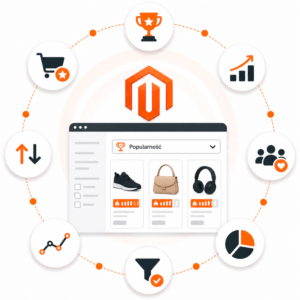
Build smart product recommendations in Magento 2 without being limited to rigid related, upsell and cross-sell relations.
Kowal_RelatedProductsProfiles is a module that lets you design custom recommendation scenarios based on profiles, product attributes, activation conditions, target filters, and flexible embedding within the store layout. As a result, recommendations stop being a static list and become part of your stores sales strategy.
Turn basic product lists into real sales scenarios
In standard Magento, related products are often too simplistic to support more demanding implementations. A store may need to show different products on the product page, different ones in the cart, and different ones during checkout. Sometimes a list should work only for selected customer groups, only during a seasonal campaign, or only when a product meets specific catalog conditions.
This module was built for exactly these cases.
Instead of manually linking products, you create a recommendation profile. A profile defines:
- where it should run,
- for which product it should be activated,
- how to select target products,
- how to narrow and sort them,
- how they should look,
- where they should be rendered,
- and whether they should feed native Magento lists.
One tool, multiple placement areas
The module works in the key areas of the store:
- product page,
- cart,
- checkout,
- native
Related Products blocks, - native
Upsell Products blocks, - native
Crosssell Products blocks.
This means one profile can become part of several different merchandising scenarios, and the implementation team does not need to build separate logic for every storefront location.
Profiles that adapt to your catalog
The biggest strength of the module is that recommendations can be built not only manually, but also dynamically based on product attributes.
You can create profiles that:
- select products from the same collection,
- find products with the same artwork,
- show products from the same category,
- promote a different product pool related to the viewed product,
- limit results to specific product types,
- run only for selected store views and customer groups.
Example?
A customer views a rashguard with artwork HALLOWEEN 25. The profile can automatically find products with the same artwork in other product lines, for example shorts, leggings, or accessories. Another profile can use the same product as context in the cart and propose complementary items from a selected assortment base.
Create recommendations based on conditions, not exceptions
Each profile can have its own:
Activation Conditions,Matching Rules,Target Product Filters,- sorting,
- product limits,
- rendering variant,
- activity time range.
In practice, this provides a huge amount of flexibility.
You can build a profile that triggers only for products with brand = Nike, only in a B2C store, only for retail customers, and only during a specific campaign. You can also build a profile that uses the cart product as a reference point and suggests add-ons based on shared catalog characteristics.
This is no longer a simple product list. It is a rule-based recommendation engine that can be aligned with a real store sales model.
Choose which product should be the context
On the product page, the context is the current product. But in the cart and checkout, the answer is not always obvious. That is why the module lets you define a Context Strategy, meaning the method of selecting the contextual product.
You can decide that profiles should be based on:
- the first product in the cart,
- the most recently added product,
- the highest-priced product.
This flexibility makes a major difference in projects where customers add multiple different products to the cart and recommendations must follow specific business logic.
Separate scenarios for product page, cart, and checkout
What works well on the PDP does not always make sense in the cart. The module lets you separate these scenarios without multiplying dedicated extensions.
On the product page you can display products from the same collection or style. In the cart you can promote add-ons that increase order value. In checkout you can prepare a simplified, more conservative list that supports cross-sell.
All of this within one profile system.
Feed native Magento lists: append or replace
Not every store wants to abandon native Magento mechanisms right away. That is why the module supports integration with:
Related Products,Upsell Products,Crosssell Products.
Each profile can run in one of two modes:
append
keeps native products and adds the module results to them,replace
fully replaces the native list with products from the profile.
This is a very convenient implementation approach. You can start by lightly extending existing Magento lists and later move to full recommendation control from profiles.
Render exactly where you need
A major advantage of the module is the ability to control the rendering location using XML fields assigned to a profile.
Instead of fitting the module into one rigid layout, you can place the list exactly where the project needs it:
- below the product description,
- below the price,
- below the add-to-cart form,
- in an additional section,
- in a custom theme container,
- in a location defined by a custom frontend layout.
This is especially important in stores built on advanced or heavily customized themes. The module does not force a single layout. You decide where and how the profile should be embedded.
Three frontend display variants
The module does not stop at product selection logic. It also lets you tailor how the list is presented to the page type and implementation needs.
Available variants:
This allows you to use the same recommendation engine for an extended section on the product page, a tight list in the cart, or a more compact module during checkout.
It also provides control over view elements:
- product name,
- price,
- regular price,
- short description,
- add to cart button,
- image role.
Creating new profiles is clear and scalable
The module was built so an implementation or agency team can develop additional scenarios without rebuilding the entire solution.
When creating a new profile, you configure:
- basic administrative information,
- placements and scope,
- store views and customer groups,
- context strategy,
- activity date range,
- activation conditions,
- matching rules,
- target product filters,
- sorting and display mode,
- integration with native Magento lists,
- XML embedding.
This means that a new merchandising scenario does not immediately require another custom module. Very often, another profile is enough.
Real-world use cases
1. Same artwork, different product base
A customer views a product from a specific line. Based on matching rules, the module finds products with the same artwork but from other assortment families. This is an excellent scenario for lifestyle, sports, and fashion brands.
2. Cross-sell based on a cart product
The customer already has a selected product in the cart. The profile uses it as context and selects add-ons that match the purchase but are not manually linked as native cross-sells.
3. Time-limited campaign
Need recommendations that run only during a specific sales action? Just configure a profile with From Date and To Date without building additional logic.
4. Replacing native upsells
If standard Magento upsells are too simplified, a profile can take over in replace mode and deliver much more precise product matching.
5. Integration with a custom theme
Thanks to XML fields, the list can be embedded exactly where the projects frontend requires it, without building another dedicated layout extension.
Who this module is for
Kowal_RelatedProductsProfiles is especially valuable for:
- Magento 2 implementation agencies,
- software houses developing e-commerce stores,
- merchants who want to decouple recommendation logic from manually maintained relations,
- projects with a large catalog and many business attributes,
- stores using custom themes and complex layouts.
What you gain
By purchasing the module, you gain not just another product list, but a tool for designing your own recommendation scenarios in Magento 2.
This solution:
- increases implementation flexibility,
- organizes merchandising logic,
- reduces the need to code more edge cases,
- leverages catalog attributes more effectively,
- lets you grow the store without rebuilding the entire recommendation mechanism.
If standard related, upsell and cross-sell are too limited for your project, Kowal_RelatedProductsProfiles adds a control layer that Magento simply does not provide out of the box.


 WhatsApp
 +48608012047